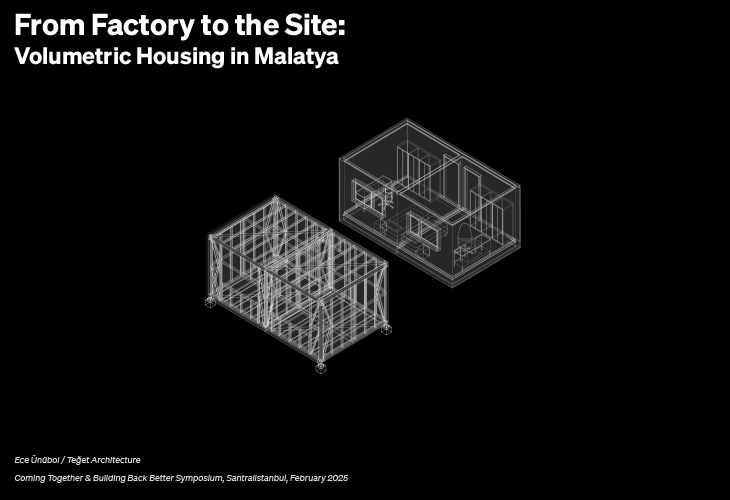
Bilgi Üniversitesi’nin düzenlediği Coming Together and Building Back Better sempozyumunda Ece Ünübol, modüler hafif çelik yapılar ve Malatya İş Bankası Lojmanları projesini anlattı. Sempozyumda 6 Şubat 2023 depremlerinin etkileri, barınma çözümleri, dirençli yeniden inşa süreçleri, topluluk desteği, risk azaltma politikaları ve dayanıklılığın artırılması konuları tartışıldı.
Sunum: From Factory to the Site: Volumetric Housing in Malatya


Abstract:
From Factory to the Site: Volumetric Housing in Malatya
In recent years the construction systems and design strategies are in a rapid change due to the natural disasters along with the economic, social and cultural crisis that emerged. For the future concerns and expectations of the community, the construction industry has been facing a compulsory transformation in which modular systems play a key role.
There are three different modes of modularization with various tectonic expressions in which steel, timber, reinforced concrete or hybrid form of the predecessor materials are used. Steel, on the other hand, is highly preferable in the construction industry in Turkey, as it is more accessible in terms of production rates and methods, and has a sustainable lifespan throughout the construction.
We, as Teğet Architecture, have been working with the modular off-site construction systems with different materials, modes and typologies for more than fifteen years. The projects are in a variety of subjects consisting of accommodation, culture, education and housing in both public and private use. Exploring the limits, capacity and compatibility of the construction system in each project, we have been developing solutions for different problems while emphasizing the importance of the on-going transformation and the role of the architect in the construction industry.
As offsite modular housing has a number of both short and long term benefits in terms of resilience, sustainability and responsiveness, after the 6th February Earthquakes in Turkey, we had worked on several projects for long-term residential use. Not only technical advantages such as efficiency in design, building physics, logistics and construction, but also social and spatial improvements for the workers, employers and last-users, come along with the off-site construction.
Within this scope, a housing project in which İşbank is the client and Consera is the industrial partner, for the employees of İşbank in Malatya, was developed and is at the technical design stage. The project consists of four blocks and 80 units which are 3+1 apartments and identical to each other. There are 5 types of volumetric modules, including living room, master bedroom, standard bedroom, kitchen and bathroom, that are fully produced in the factory and delivered to the site for the assembly. Non-module elements are roofs, corridors and apartment halls and balconies that are constructed with lightweight steel and staircases that are constructed with structural steel for the stability of the building. Due to the regulations, all four buildings have reinforced concrete basement floors consisting of technical areas. Before the construction, it was planned to make mock ups of the modules in the factory in Malatya, which was particularly found for this project, considering the transportation cost and management.
İşbank Malatya Housing project is the first high rise prefabricated modular building in Turkey. Thus it has an importance both for the construction industry, local administration and academic community. The project will provide not only an alternative to traditional construction methods and immediate solutions after disasters, offering sustainability and adaptability for different conditions but also a case study for academic research in disaster-resilient architecture and modular construction technologies.
